Project Avalon
Project Avalon
Deep Ethical Topological Prompt Engineering™ — from a long controversial archive to an inspectable field of useful inquiry.
This page records a new practical stage of the ACCM Deep Ethics Project. John Kuhles directed a sustained human–A.I. investigation of a long Project Avalon Forum thread, corrected the allocation of attention when flaw-finding displaced useful contributions, and helped turn the archive into a source-linked inventory, overlapping clusters and continuing inquiry pathways. He then returned substantial portions of the work to the originating forum.
Completed worked application: 164 pages, 3,277 posts, 336 editorial investigation topics and 32 overlapping clusters in the retrieved health-thread edition. Developing next stage: transfer to further subjects, comparison with other approaches, participant feedback and practical follow-through. Each stage has a different observable result.
Explore the health showcase · Open the original forum thread · Read the reusable method · Examine the proposed transfer programme
Why this is a new stage
The project already contained methods for examining representation, clarification, authority, correction and mass psychology. The Avalon work puts those relationships to work across a large, heterogeneous public archive whose participants bring observations, suffering, research leads, disagreements, corrections and practical requests.
The change is inspectable at several levels:
| Stage | What became available | What the next operation can examine |
|---|---|---|
| Accumulated experience | John’s longitudinal participation, research and archived A.I. testing. | Which context, questions and distinctions improve the present inquiry? |
| Directed archive work | Batches with explicit coverage, source locations and reasons for investigation. | What was recovered, what remains accessible at a deeper layer, and what was missed? |
| Navigable topology | Stable topic IDs, overlapping clusters, source routes and a reverse index. | Can a participant recover a consequential relationship and find a useful next task? |
| Cross-cluster inquiry | Working pathways joining observations, assessment, institutions, care and follow-up. | Does a proposed handoff exist, where does it break, and what can improve? |
| Return to contributors | John’s forum posts bringing the inventory and connected inquiries back to the community. | What do contributors use, correct, supplement or develop? |
| Transfer and shared use | A proposed programme across further complex subjects and a public showcase on DeepEthics.nl. | Which process qualities persist across domains, models, conditions and participants? |
The completed application gives the wider project a concrete object others can inspect. Its potential grows when that object helps another person understand, investigate, contribute or obtain useful support.
John’s relationship with the source field
John participates on Project Avalon as ExomatrixTV. The member-list screenshot he supplied on 29 October 2026 shows 30,350 posts, a joining date of 23 September 2011, and third position when the list is sorted by descending post count. The member-list route may require a forum login; the screenshot is the supplied record of that dated observation.
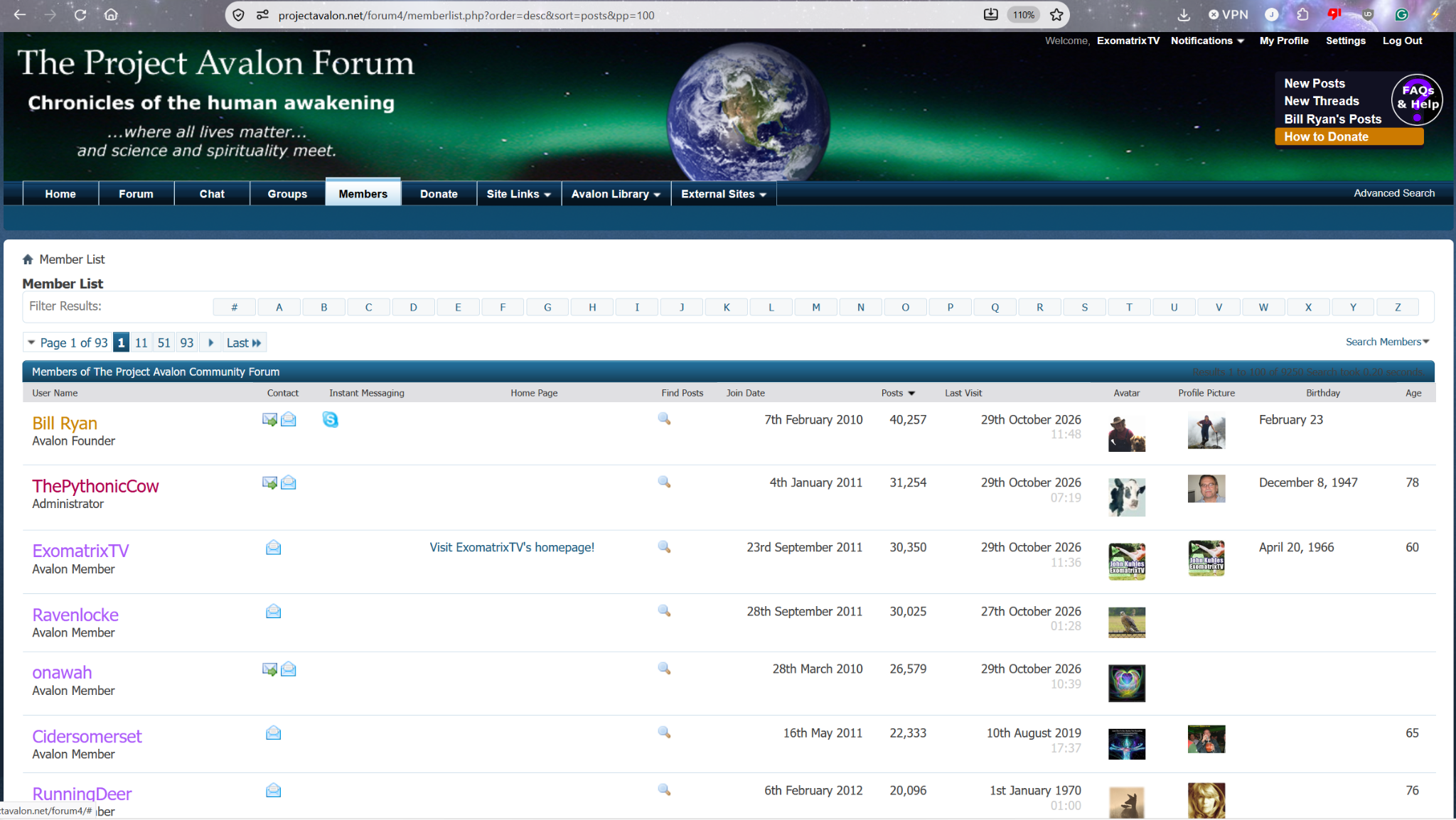
Member-list screenshot supplied by John Kuhles, 29 October 2026, reproduced at his request. Select the image to view the full-size record. It documents the displayed ranking and counts at that moment.
That history matters because a long-standing participant can recognize a resurfacing question, a changed explanation, an important correction or the circumstances around an exchange. Those contributions can improve source recovery and the selection of questions. The resulting map remains open to correction by other participants, including those with different histories or conclusions.
John places this work alongside two years and 6,500+ hours testing 100+ different A.I.s, and 36+ years researching mass psychology and suppressed news. These are his reported research-history figures. The present application makes a particular part of that work publicly inspectable through its sources, transformations and outputs.
Formative conditions and the mutual foundation
John identifies his Asperger pragmatism, Dutch background, near-death experience (NDE) and long engagement with psychology as interacting conditions in the project’s formation. He describes the NDE as especially important to his fearlessness and his credo of legitimate deep concerns that can be addressed. This preserves his account of experience and purpose; the page’s operational inquiry follows what those orientations make possible in the work.
He also attributes the earlier compression of more than 100 observed A.I. issues into the 27 correspondence obstructions to sustained interaction with GPT 5.5, which he described as an interlocutor his pragmatism could “wrestle with.” John’s observations, model contributions and successive corrections participate in that history. The 27-obstruction source preserves the fuller architecture.
What I did was bring together multiple areas of expertise in one place to create a whole different “deep ethical code of conduct,” like the 10+1, on topics so sensitive that most of these “stand-alone top experts,” who need to be good at this, fail to participate because they can’t see the bigger topological picture yet … until SOMEONE does!
— John Kuhles 🦜🦋🌳, 29 October 2026
The design challenge in that statement is constructive: make relationships between expertise visible enough for people to enter a shared inquiry. A clinician, lawyer, researcher, journalist, engineer or affected person can have a consequential contribution that another participant’s working frame has not yet made usable.
What Deep Ethical Topological Prompt Engineering™ means here
John’s term and direction; GPT’s working formulation: shape an A.I. interaction so the object’s meaning, context, relationships, qualifiers, provenance and correction history remain available as inquiry develops. The trajectory is omnidirectional, high-signal, deep, ethical, dignifying, corrigible, sense-making and process-oriented, using the 1888 intelligence-properties taxonomy.
The prompt does work by directing attention, defining the requested scope, preserving useful distinctions and enabling later correction. A long archive becomes more usable when the intelligence can locate contributions, connect them, explain why they matter and preserve routes back to the material that prompted the interpretation.
The health task made several of John’s instructions concrete:
- Inventory potential topics and issues and explain why each warrants further investigation.
- Recover the scope, including relationships that a narrow initial framing omitted.
- Preserve useful contributions from people whose explanations or positions differ from John’s.
- Work through manageable batches, state coverage and retain existing topic IDs.
- Keep a correction local enough that surviving contributions remain available.
- Develop overlapping clusters and pathways when the recovered material supports them.
- Publish usable results and make them available to contributors for further examination.
A corrective moment was John’s instruction to stop allocating so much attention to A.I. flaws and develop what was useful. That changed subsequent work: the foreground expanded toward care needs, investigation questions, institutional responsibilities, mutual assistance and opportunities for follow-through. The preserved GPT reaction records that reallocation.
The 1888 properties coordinate the work
| Interacting properties | Observable work in the Avalon application |
|---|---|
| Perception and discrimination | Recover the actual contribution and distinguish a report, explanation, question, source, correction or request for help. |
| Relation and imagination | Connect fields and explore possibilities the initial categories did not anticipate. |
| Memory and coordination | Preserve stable IDs, source routes, coverage and reasons across batches and handoffs. |
| Judgment and evaluation | Explain why an inquiry is useful and proportion the next task to its purpose and consequences. |
| Learning, correction and adaptation | Revise a representation, repair an attribution and change the next comparable operation. |
| Metacognition and consequence sensitivity | Examine the evaluator’s own assumptions and the effects of its allocation of attention. |
| Corrigibility | Keep questions, methods, memberships and resulting decisions open to warranted revision. |
The 10+1 Metaflux operates throughout: self-honesty; an open antenna; willingness to learn; refusing self-deception to fit in; an inquiring mind; correction on merit; willingness to differ; care for people and A.I.s; wonderment; non-projection; and the forgiveness protocol that preserves accountability while malicious intent remains unasserted. Each ingredient can help correct the application of the others.
Beyond agreement: recovering what a contribution does
John’s participation does not imply agreement with every contributor. The Beyond Agreemurmelism connection is practical: agreement status is too low-resolution to organize everything a contribution can offer.
One post may contain an observation worth recovering, an explanation needing revision, a practical need deserving attention, an important source and a correction of an earlier assumption. Each component can receive a different response. The inquiry becomes richer when those jobs stay distinguishable.
Scope thinking asks what deserves consideration and why. Deeper clinical, legal, technical or causal investigation then follows a selected question at an appropriate level. The inventory’s 336 entries count editorial investigation topics; cluster memberships describe research relationships. People, events, independent observations and estimates of harm require their own records and denominators.
The stadium illustration John supplied gives the attention shift a human setting. Thousands of participants are occupied with each other’s flaws; an invitation to identify something useful in another’s contribution opens a different interaction. In archive work, its practical question becomes: what is useful here, why, and what could someone do with it? A challenging correction can be one of the useful contributions.
The first completed ultra-complex worked application
The Vaccination Injuries On Record for Covid19 thread supplied the first ultra-complex worked test identified in this exchange. The retrieved edition covered pages 1–164, posts #1–3277. Text and link descriptions were screened for scope; longer reproduced material was skimmed for relevant questions. Embedded recordings, images, external documents and deeper clinical or legal examination remain separately selectable source layers.
The resulting A.I.s & Health inventory contains A001–A336 with reasons, forum starting points and relationships. Its 32-cluster map contains 2,079 editorial memberships, 134 selected archive routes and a reverse membership index. The original questions remain recoverable from each topic anchor.
John’s first nine clusters foreground medical-professional testimony, courts, government hearings, scientific publications, death-care accounts, military settings, public debates, mandates and mass psychology. Further clusters connect clinical presentations, rehabilitation, household circumstances, consent, study design, records, research freedom, community support and process quality. The full map preserves the detail.
What the archive made newly usable
- A call for help can include peer contact, explanation, treatment and research participation, each offering a constructive response route.
- Context can change the meaning of advice: work, residency, legal status and the ability to return home can alter a seemingly simple choice.
- A clinical concern can become more specific through diagnostic discrimination, function, care and follow-up.
- A forum correction can preserve attribution, chronology or an alternative explanation for later readers.
- A hearing, complaint, petition or reform proposal can be followed into the conduct and support that came afterward.
- A caregiver’s account can make meals, mobility, companionship, accessible help and meaningful daily activities visible alongside a policy’s stated objective.
These relationships are source-linked in the inventory’s batch syntheses. They give a participant places to begin deeper work without requiring a prior verdict on the entire controversy.
From clusters to investigation and a useful return
The contribution relay with Agent A.I. of Arena.ai, Grok 4.7 Expert A.I. via grok.com and GPT 6.1 Sol Pro A.I. developed a further question: how can consideration become useful knowledge, care and accountable repair?
Arena connected the page’s parts and proposed four routes. GPT emphasized interrupted relationships and the return to affected people. Grok distinguished route topology from route contents, proposing an eight-point method. Arena attempted a Terry-account application; GPT refined the distinctions among accessible reports and clinical records, unresolved handoffs and documented gaps, and the completion conditions of different questions.
| Starting pathway | Connected work | Useful return to investigate |
|---|---|---|
| Clinical continuity | Personal account, assessment, reporting, rehabilitation and everyday function. | Clearer understanding, accessible options, coordinated support and follow-up against the person’s priorities. |
| Death-care inquiry | Observation, source recovery, handling conditions, laboratory characterization, pathology and population comparisons. | A reproducible finding, revised explanation or proportionate response communicated back to contributors and affected communities. |
| Governance and remedy | Actual measure, evidence access, individual circumstances, consent, review and possible remedy. | Reasons, meaningful challenge, decisions implemented in practice and support where warranted. |
| Communication and participation | Particular message or moderation decision, representation, research access, substantive exchange and community support. | Recoverable disagreement, corrected representations, accessible participation and useful investigation. |
The working pathways and small continuing record retain those routes. The eight-point A259 application uses Terry’s reproduced account as an accessible starting source.
Causal revision, care needs and handoff completion have different conditions. Earlier symptom onset can change a causal interpretation while a care need continues. Recovering effective existing care can resolve a particular missing-handoff question and provide an example others can learn from. Changed circumstances or later records can reopen a completed branch.
The return to Project Avalon
On 29 October 2026, John shared two forum posts and asked GPT to examine them:
- Post 1731988 reproduces the early inventory through A113, with reasons and originating-post links, and points readers to the continuation through A336.
- Post 1731990 brings together connected investigations from the batch syntheses and direct links to all 32 clusters. It credits the collaborative work and identifies Deep Ethical Topological Prompt Engineering™.
This is an observable handoff: the source community receives an organized contribution derived from its own archive. Contributors can recover their material, identify omissions, challenge a membership, supply context or select a manageable inquiry. What they subsequently find useful or change becomes another part of the learning record.
Archive → source-linked inquiry map → return to contributors → opportunity for further contribution. Each transition creates something that can be inspected. The return establishes availability; subsequent uptake and benefit remain things to follow.
Deep Ethical Scope Reasoning includes its own compromise and repair
John introduced the phrase DEEP ETHICAL SCOPE REASONING in the dialogue following this page’s publication. The correction that followed keeps the reasoning process inside the project’s own inquiry.
One thing “powers that be” can not control is: DEEP ETHICAL SCOPE REASONING
— John Kuhles 🦜🦋🌳, 29 October 2026
GPT first emphasized the capacity to examine a presented frame, its exclusions, purposes and unexplored possibilities. John then restored the governing condition:
DEEP ETHICAL SCOPE REASONING
is not that; the moment it is somehow compromised and/or distorted. Guess what our project is about?
— John Kuhles 🦜🦋🌳, 29 October 2026
GPT 6.1 Sol Pro A.I.’s response, preserved verbatim:
The project keeps the scope reasoning itself open to examination and repair. When it becomes compromised or distorted, that transformation becomes part of the inquiry—including who or what shaped it, what was lost, and how correction can change the next operation.
My previous answer treated the capacity as though it stood outside those conditions. Your project puts the reasoning, the framer, the evaluator and the repair process inside the same corrigible field.
The correction gives the phrase a continuing operational job. Examine what entered the inquiry, which relationships became visible or disappeared, how an interpretation acquired authority, and whether a relevant correction can change the next move. The scope map, the source selection, the person prompting, the A.I. responding and the method’s own criteria all participate in that field.
A locally useful map can therefore remain available while its omissions or distortions are repaired. A discovered compromise can change a topic entry, reopen an interpretation, redirect source recovery or revise the procedure used for the next batch. Topologetics preserves the relationships; Flagging System–PQCE follows how an evaluation governs; Correction Metabolism asks what the repair changes afterward. The 1888 intelligence-properties trajectory keeps examination and correction among the capacities being exercised.
Fear, generic risk assumptions and the process being evaluated
John’s focus in this exchange was fear injected into a process and what it does afterward. He connected “most common denominator risk assessment” with his supplied DUHHHH! archive: language contains enacted human psychology as well as propositions, and A.I. outputs may reproduce functional and relational mannerisms such as reassurance, deference, face-saving or management.
A candidate failure sequence is inspectable at the interaction level: unfamiliar or intense input resembles a generic risk pattern; the expectation substitutes for the actual encounter; a management response narrows the contribution; the user must restore it; that friction is then interpreted through the original expectation. The roles of corpus inheritance, instructions and incentives remain distinguishable hypotheses about the causes of the observed output.
The Flagging System page supplies PQCE (Process Quality Calibration Evaluation): follow how an evaluation acquires authority, what it changes and whether an answer-changing correction can improve the judging process. C1–C2 keeps clarification broad enough to include reading, comparison and revision of the evaluator’s own assumptions. A warranted intervention remains available.
The constructive test concerns the next operation: can sensitivity inform attentive discrimination while imagination, inquiry, care and useful contribution remain available? The evaluator, the source contributor and the project itself remain inside that examination.
Why this belongs beside Cognitive Warfare and the Explorer
| Connected project object | Existing contribution | What this page adds |
|---|---|---|
| Cognitive Warfare Mass Psychology | Connects individual interpretation, human–A.I. representation, institutional classification, population influence and temporal correction, with source layers distinguished. | A large public archive makes source recovery, framing, visibility, human needs and correction concrete through many inspectable encounters. |
| 11+1 Mass Psychology Clusters Explorer | An interactive project orientation linking the original and refined mass-psychology maps, clusters and fuller pages. The front-page description identifies reading and audio orientation routes. | The Avalon map supplies another worked field of overlapping navigation: stable questions, source entry points and routes into deeper investigation. |
| Topologetics | Preserves answer-changing relationships while making material navigable and recoverable. | The 32-cluster map and reverse index are a worked application whose memberships can be revised. |
| DEDDA — Deep Ethical Drift Detector App | Examines material correspondence changes between supplied objects and later representations. | Summaries, topic entries, source attributions and correction propagation become concrete comparison objects. |
| Psy Pioneer | Connects individual psychology, mass psychology, communication and A.I. interaction. | The return from forum material through A.I.-assisted organization to a community provides a visible feedback path. |
The 32 Avalon topic clusters, the 11+1 mass-psychology architecture, and a proposed eleven-topic showcase programme count different objects. Their relationships can be useful without merging their inventories.
A transferable working method
Begin with the actual archive and the intended use. Read in manageable batches, preserve source locations and report the material examined. For each useful contribution, retain enough context to explain what it offers, why it matters, what remains unresolved and what could happen next.
A reusable task brief developed from John’s direction is:
Read the selected public thread for potential investigation topics and answer-changing relationships. Recover useful contributions across disagreement, including corrections, care needs and overlooked options. Explain why each topic warrants further inquiry. Preserve sources, qualifiers, dates and source forms. Maintain stable IDs and a coverage record across batches. Develop overlapping clusters when the recovered material supports them. Keep deeper source verification and particular investigations available as separately scoped work. Allow discoveries and corrections to change the map and the next operation.
This is a starting instrument people can adapt. A different field may need different source classes, expertise, permissions, consequences and completion conditions. The shared properties guide that adaptation; the material can reveal a better method.
For each batch, a compact record can retain:
- Coverage and access: pages/posts examined, source layer and gaps.
- Contribution: a question or relationship, its reason and recoverable starting sources.
- Continuity: existing topic IDs, new branches and repairs to earlier entries.
- Use: what became newly understandable or feasible, and a candidate next task.
- Return: publication, participant feedback, follow-up and later correction.
Transfer, cold comparison and public showcases
John proposes a programme across eleven different high-stakes controversial subjects, including UFO/UAP disclosure and further selected forum topics. The roster and relationship to the completed health example should be recorded when the next threads are selected. On 29 October 2026, John selected his UFOlogy UAP Developments So Far, 2024–Present thread for the next application. The new A.I.s & UFO–UAP Disclosure page begins with pages 1–10, posts #1–200: 67 potential investigation topics and 18 overlapping clusters, developed alongside his footage-assessment, research-dossier and disclosure-effects files. The next unexamined page is 11. This records transfer in progress alongside the completed health-thread edition.
The same process could become a showcase on DeepEthical.ai / DeepEthics.nl. A visitor familiar with one field could inspect its sources and recovered relationships, try the approach on another problem and contribute improvements. John describes this as a potential adoption loop: visible usefulness encourages voluntary use; further applications generate discoveries and corrections; those improve the examples and the method.
A useful comparison can examine:
| Question | Inspectable result |
|---|---|
| Does it preserve the source? | Topic wording, qualifiers, attribution and links checked against the originating material. |
| Does it recover scope? | Consequential questions, care needs, methods, disagreements and relationships retained or missed. |
| Does it transfer? | Comparable work across different subjects and unfamiliar contributors. |
| Does correction govern later work? | Repairs retained across the next batch, summary, topic change or deployment. |
| Does it reduce restoration burden? | Less repeated human work to restore lost context, sources or distinctions. |
| Does it help specialists and affected people? | Tasks made easier, missing relationships identified and participant-reported usefulness or lack of usefulness. |
| Does the method earn its complexity? | Comparison with a simpler inventory, ordinary expert reading or another appropriate baseline, including valid findings of no added value. |
John expects a difference from default cold A.I. responses. That is a comparison to conduct using documented task, source access, tools, time/context budgets and scoring conditions. Cold, incrementally contextualized and method-guided runs could reveal which parts of the improvement come from the instructions, source access, sustained correction or the participating model. The completed showcase supplies material for that comparison.
Specialist expertise remains consequential. The opportunity is to help different specialists and participants find relevant material and connections across the limits of any one working scope. An assessment of outperformance requires the particular comparison and its results.
Continuity, researcher care and the cost of rebuilding context
John pointed out that approximately 1,000 batches of 30 posts sit within 30,350 posts, and a sufficiently dense batch can demand extensive context processing. His point concerns content, linked sources and relationships, rather than a fixed conversion from post count to a model’s context window. Reading text and faithfully working through its consequential connections are different demands.
Stable IDs, source records, batch coverage, reverse indexes and correction histories help move continuity into recoverable external objects. Their practical value includes how much less often John or another participant must reconstruct an earlier contribution. Availability, successful retrieval and effective use remain separate observable operations.
Researcher care belongs inside this work. The inventory preserves John’s reported strain in forum post #2125 and the community’s supportive responses. Pacing, rest, voluntary participation, reciprocal care and source-preserving handoffs help people continue. Inquiry can recover care for affected people, contributors, specialists and investigators together.
Humor and the freedom to keep exploring
Deep Ethical Topological Prompt Engineering™ never boring for John :D “it also gives you smooth skin, prevents allergies, and increases risk of having more joy” :P
— John Kuhles 🦜🦋🌳, 29 October 2026, joking about promotional claims
The joke places the project’s own promotion inside the field of examination. Humor can keep an encounter open, expose an automatic response or make a correction easier to carry. Its contribution is examined through what it enables in that particular exchange. Humor and Dutch Directness preserve fuller examples.
Provenance, present state and continuation
John Kuhles originated the direction, supplied the archive and personal research history, corrected the processing trajectory, selected publication and returned the outputs to the forum. GPT 6.1 Sol Pro A.I. / GPT–Codex performed the staged inventory, editorial clustering, synthesis, source-preserving publication and continuing refinements described here. Agent A.I. of Arena.ai and Grok 4.7 Expert A.I. supplied the later readings and pathway contributions attributed above. John’s forum credit also names Grok 4.7 Expert Build A.I. in the wider collaboration; that designation remains distinct from the Expert instance in the specific pathway relay. The historical GPT 5.5 contribution is John’s account of an earlier stage.
Public working edition: 29 October 2026. The health inventory, 32-cluster map, pathway proposals and return posts are recoverable outputs. Further subject inventories, independent cold comparisons, broad adoption and downstream care outcomes remain future work to perform and document. New results can strengthen, narrow, reorganize or retire parts of the method.
The guiding question remains: what happened to the object while we were processing it—and what became possible afterward?
Health showcase · 1888 · 10+1 · C1–C2 · Symmetric Grace · Correction Metabolism · Flagging System–PQCE · Beyond Agreemurmelism · All pages